Where you live matters less every year. Clients on Upwork, agencies hiring remote specialists and businesses looking for automation help do not ask which city you are in. They ask one thing: can you solve the problem? If you have a laptop, a stable connection and the right skill, you can do that work from anywhere in the world, and you can learn it online.
The hard part is choosing. Search for “online IT courses” and you get thousands of options, most of them generic. This guide narrows it down to six practical skills that businesses pay for right now, explains what each one leads to, and helps you pick the one that fits you.
Why practical skills beat general courses
The World Economic Forum’s Future of Jobs Report 2025 lists AI and big data, networks and cybersecurity, and technological literacy as the fastest-growing skills employers need. Notice what is missing: nobody is hiring for “basic computer knowledge”. Demand is for specific skills that solve a business problem, such as building a site that brings in leads, or automating a process that wastes ten hours a week.
That is how the six skills below were chosen.
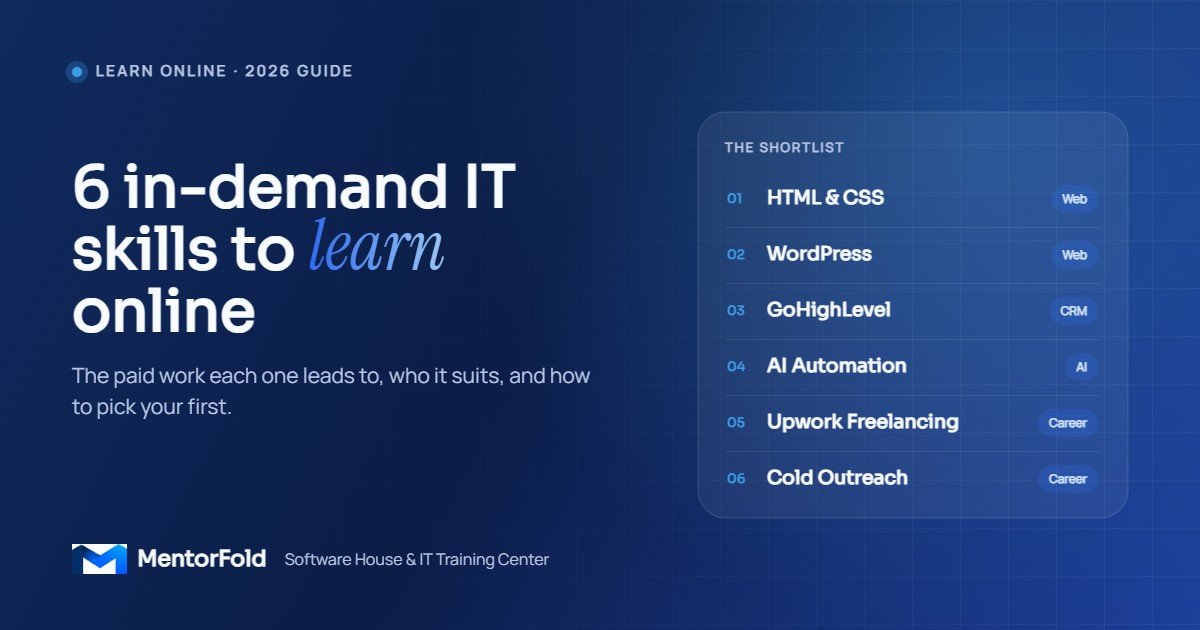
The 6 skills at a glance
- HTML & CSS: the foundation of every website. The best first step for complete beginners.
- WordPress Development: builds real business websites fast. The quickest route to paid web work.
- GoHighLevel: a CRM and marketing platform used by agencies worldwide. A specialist niche with steady demand.
- AI Automation & AI Agents: connecting tools like Make.com, Zapier and n8n with AI so businesses save hours every week.
- Upwork Freelancing: turning any skill into income through profiles, proposals and client communication.
- LinkedIn & Cold Email Outreach: finding clients directly instead of waiting for them.
1. HTML & CSS: start here if you are new
Every website you have ever opened is built on HTML (the structure) and CSS (the design). Learning them teaches you how the web actually works, and makes every other web skill easier to pick up.
Who it suits: complete beginners, students, and anyone who wants to understand websites rather than only use them.
What it leads to: landing pages, website edits for clients, and a strong base for WordPress or front-end development.
See the HTML and CSS Development course.
2. WordPress: the fastest path to paid web work
WordPress powers a huge share of the world’s websites, from small shops to large publishers. Businesses constantly need someone to build, fix, speed up or maintain their WordPress site, which makes it one of the most reliable skills for a first freelance income.
Who it suits: people who want to build complete websites without years of programming.
What it leads to: business websites, maintenance contracts, and small monthly retainers that add up.
See the WordPress Development course.
3. GoHighLevel: a niche with less competition
GoHighLevel (often called GHL) is an all-in-one platform that marketing agencies use for funnels, pipelines, booking and automated follow-up. Agencies hire specialists to set it up and run it, and many of those roles are fully remote.
Who it suits: organised people who like systems, virtual assistants who want a higher-value skill, and anyone interested in marketing.
What it leads to: CRM setup projects, funnel building, and long-term roles with agencies.
See the GoHighLevel Mastery course.
4. AI Automation & AI Agents: the newest opportunity
Most businesses repeat the same tasks every day: copying leads into a spreadsheet, sending reminders, answering the same questions. Automation tools like Make.com, Zapier and n8n, combined with AI, can do that work automatically. People who can design these workflows are still in short supply.
Who it suits: logical thinkers who enjoy solving puzzles. Comfort with computers helps; deep coding is not required to start.
What it leads to: automation projects for businesses, chatbot setups, and AI agent builds.
See the AI Automation and AI Agents course.
5. Upwork Freelancing: turn a skill into income
Many people learn a skill well and still earn nothing, because they do not know how to present it. A strong profile, a focused portfolio and proposals that speak to the client’s actual problem make the difference between silence and your first contract.
Who it suits: anyone who already has, or is learning, a skill from this list.
What it leads to: your first clients, reviews, and a profile that keeps bringing in work.
See the Upwork Freelancing and Client Acquisition course.
6. LinkedIn & Cold Email Outreach: find clients directly
Marketplaces are competitive. The freelancers and agencies who grow fastest also reach clients directly, with a professional LinkedIn presence and short, personal emails to the right businesses. It is also a skill companies hire for on its own, as lead generation.
Who it suits: confident communicators, and freelancers who want to stop depending on one platform.
What it leads to: direct clients, higher rates, and lead generation work.
See the LinkedIn and Cold Email Outreach course.
How to choose your first skill
Ask yourself three questions:
- Do I enjoy design and seeing results on screen? Start with HTML & CSS, then WordPress.
- Do I enjoy systems, logic and organising things? Choose GoHighLevel or AI Automation.
- Do I already have a skill but no clients? Go straight to Upwork Freelancing or Outreach.
Skills also combine well. WordPress with HTML & CSS makes you a stronger web developer, and GoHighLevel with AI automation lets you offer agencies a complete package. Pick one to start, get your first result, then add the next.
What to look for in an online IT course
- Practice over theory. You should build real things in every lesson, not just watch videos.
- A portfolio by the end. Clients hire from examples, not certificates.
- Help getting work. Learning the skill is half the job; finding clients is the other half.
- A real mentor. Recorded videos cannot answer your questions. Being able to get unstuck quickly saves weeks.
Frequently asked questions
Can I learn these skills online without a computer science degree?
Yes. All six are practical skills. Clients judge you by your work and your communication, not your degree.
What do I need to learn online?
A laptop or desktop computer, a reliable internet connection, and a few focused hours each week. Every tool covered in these courses runs in the browser or on a standard computer.
Which skill gets results fastest?
For most beginners, WordPress is the quickest route to paid work, because businesses everywhere need websites. If you already have a skill, freelancing and outreach training gets you to clients faster.
Can I take MentorFold’s training from another country?
Yes. MentorFold offers its training online, so you can learn from anywhere. Get in touch for schedules and details.
Need the work done instead?
If you are a business owner rather than a learner, the same team that teaches these skills builds them for clients around the world: websites, GoHighLevel setups, AI automation and lead generation.
Ready to start?
Not sure which skill is right for you? Tell us your background and goals, and we will suggest where to begin. Contact MentorFold, message us on WhatsApp, or browse all MentorFold trainings.